A close look at night, storms, silhouettes, and the visual cues that remain dependable when the horizon disappears.
The mountain changes its vocabulary
Alto's Adventure does not use weather only as decoration. Light, fog, storms, and night alter which visual cues reach you first. On a bright afternoon, the horizon supports long plans. In darkness, the nearest contour matters more. I improved once I stopped demanding daytime certainty from every scene and started changing how far ahead I tried to read.
Daylight supports long scanning
In clear light, use the horizon. Scan beyond the immediate hill for grind lines, roof shapes, gaps, and groups of llamas. You can often plan a sequence before reaching the first launch. I keep the next feature in central attention and the feature after it in peripheral attention. This prevents tunnel vision while still giving the current landing enough precision.
Sunset can flatten a slope
Warm light is beautiful, but similar colors can make a small rise blend into the background. Watch the sharp snow edge rather than the color inside the landscape. If the edge curves upward, expect earlier contact; if it falls away, expect more airtime. Silhouette geometry remains useful even when the palette makes depth feel ambiguous.
Night rewards a shorter plan
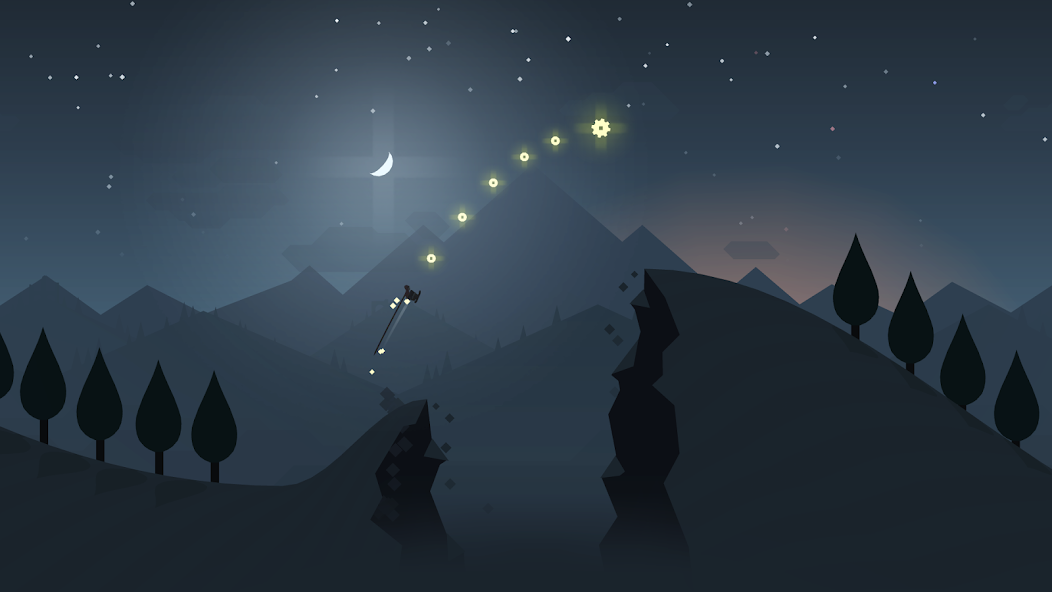
At night, I reduce the planning horizon to one confirmed action and one possible follow-up. The immediate snow line and Alto's board remain readable, while distant obstacles may arrive with little warning. A shorter plan leaves room to revise. Trying to memorize a long route from partial shapes creates false confidence and encourages a hold before the landing is known.
Storms increase visual noise
Rain or snow movement can pull attention away from stationary hazards. Look for stable edges: the ground line, rock outlines, rails, and rooftops. I mentally classify moving particles as atmosphere and do not track them. This simple filter protects attention for objects that affect the run. Lowering screen glare can also make silhouettes easier to separate, depending on the device.
Fog calls for conservative entries
Fog limits preview distance, so enter uncertain sections with options. Avoid starting a long rotation from a weak jump when the destination is hidden. Preserve speed through clean movement, but do not mistake speed for complete information. If a safe neutral jump reveals a broad slope, the next crest may offer a better opportunity with a visible landing.
Sound can support, not replace, vision
The game's audio gives the run texture and can reinforce events, but it should not be treated as a complete obstacle alert. Use sound to maintain rhythm while keeping visual attention on the snow. Headphones may make a session immersive, yet the core landing decision still comes from board angle and terrain. If playing muted, none of the essential technique disappears.
Use the character as a contrast marker
When the landscape becomes dark, Alto's silhouette provides a stable reference. The board shows rotation, and the space beneath it hints at remaining airtime. Compare the board to the nearest visible snow segment rather than searching the whole scene for depth. This local comparison is fast and works across several weather states.
Adjust ambition without losing momentum
Conservative play does not mean crawling. Clean basic tricks and grinds can maintain speed while you wait for clear terrain. Choose lower-complexity actions when information is poor, then expand the combination when visibility returns. I think of ambition as a dial, not a switch: weather turns it down, a broad visible landing turns it back up.
Practice the transition, not just the condition
The hardest seconds often arrive while one weather state becomes another. Your eyes are still using the old contrast while the scene has already changed. When daylight fades, deliberately move attention from distant scenery to the nearby snow edge. When fog clears, widen the scan again instead of remaining locked on Alto. Naming that transition helped me adapt sooner and avoid the rushed input that often followed a sudden visual change.
Let changing conditions shape the story
The strongest runs are memorable partly because conditions evolve. A route that begins in calm light may end with cautious silhouettes under a storm. Treat those changes as new reading problems rather than interruptions. Scan farther in daylight, trust edges at sunset, shorten plans at night, and filter motion during storms. The same one-touch control then feels different without becoming arbitrary, which is a major reason the mountain stays compelling.